DTU Electro

Neuromorphic computing and signal processing training network

Illustration: AI-generated
An AI generated abstract image of neuromorphic signal flow

MINDnet’s mission is to train 15 doctoral candidates, forming the next generation of leading scientists and expert researchers in the field of neuromorphic computing and signal processing technologies.

Project overview

MINDnet's vision is to uncover new computing paradigms based upon these platforms individually, cross-platform implementations and through coupled biological and artificial systems.

key facts

  • Call: HORIZON-MSCA-2024-DN-01
  • Type of action: HORIZON-TMA-MSCA-DN
  • Acronym: MINDnet
  • Number: 101226674
  • Duration: 48 months
  • GA based on the: HE Unit MGA - Multi & Mono - 1.2
  • Estimated Project Cost: 0.00
  • Requested EU Contribution: EURO 4,664,170.08
  • Current Phase: Grant Management
  • Start Date: 01 January 2026

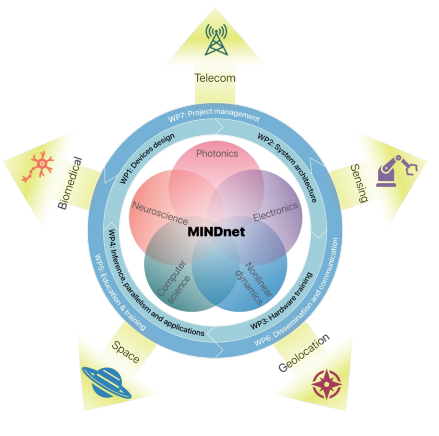
A visualization of MINDnet's project vision
MINDnet's network combining electronics, neuroscience, photonics, nonlinear dynamics and computer science 

Work packages

  • RO1: To define functional interfaces between domains - electronics, photonics, and biology: MINDnet aims to develop electro-optic and neuro-photonic interfaces exploiting the advantages of each domain and bringing the computing power closer to the domain of its input data.
  • Lead: HPE BELGIUM
  • DCs: DC1-DC5, DC7-DC10, DC13
 
  • RO2: To develop time and energy-efficient training methods for neuromorphic hardware: MINDnet aims to develop learning and training procedures that can be applied to the complex and dynamical computing hardware that will be designed within MINDnet, to achieve SOTA performances on real-world tasks while improving energy consumption, on-chip area and latency. 
  • Lead: FZJ
  • DCs: DC5, DC8, DC11-DC13, DC15
  • RO3: To develop complex nodes/architectures and scaling through parallelism: MINDnet aims to develop and employ artificial neurons with complex behaviour to build powerful and efficient hardware, that can fully exploit the unique advantages of neuromorphic computing. 
  • Lead: USTRATH
  • DCs: DC2-DC5, DC8, DC12- DC15
  • RO4: To benchmark computing performance in real-world applications: Developments within MINDnet will be exploited not only in typical benchmarks (e.g. nonlinear time-series prediction), but also in real-world applications, targeting at least telecom, sensing, space, biomedical, and geolocation.
  • Lead: TUIL
  • DCs: DC1, DC3, DC5, DC7, DC9-DC11, DC13-DC15
  • Objectives: To complement the day-to-day training through research activities by 
    • providing training through inter-disciplinary research courses relevant to the project; 
    • train DCs in transferable/soft skills (entrepreneurship, business, IPR, management, leadership, scientific writing, communication, etc.)
  • Lead Beneficiary: UCL 
 
  • Objectives: Dissemination and exploitation of results and scientific advancements, as well as increasing awareness in the general public of the benefit and need for new researchers. 
    • Promote two-way knowledge and data share and transfer between academic and non-academic partners; 
    • Maximize industrial uptake of knowledge, to ensure value creation and commercial exploitation of R&D results; 
    • Disseminate project concepts, ideas and results to the general public; 
    • Identify, assess and protect all relevant project results.
  • Lead Beneficiary: SCS 
 
  • Objectives
    • To ensure a smooth running of the project, including communication between the consortium and the EC, so that all knowledge is created, managed and disseminated in a coordinated and coherent manner and all training activities, financial and legal aspects, and other issues are managed transparently at a high standard; 
    • To ensure that the EC requirements for communication and reporting are met.
  • Lead Beneficiary: DTU 

doctoral candidates

We have gathered the best European academic and industrial partners to train 15 Doctoral Candidates to an outstanding level, where they can act as Europe's future leaders within neuromorphic computing and signal processing technology. 
AI-generated illustration of futuristic neural waveform

Consortium

AI-generated image of abstract photonic circuits

Beneficiaries

Associated partners

Funding

Flag of the European Union and text saying: 'Funded by the European Union'
This project has received funding from the European Union’s Horizon Europe’s Research and innovation Programme under the Marie Skłodowska-Curie Grant Agreement No. 101226674

Events and outreach

Stay updated with our latest activities and upcoming events.

Stay tuned for updates on project milestones, research publications, conferences, and workshops and more. News and events will be posted here as the project progresses.

Contact

Project Coordinator

Francesco Da Ros

Francesco Da Ros Associate Professor Department of Electrical and Photonics Engineering